Here's a question most families don't think to ask when hiring a support worker: *Would this person and my loved one enjoy grabbing coffee together?*
The "Coffee Test": Why Shared Hobbies Matter More Than 20 Years of Experience
![[HERO] The "Coffee Test": Why Shared Hobbies Matter More Than 20 Years of Experience](https://cdn.marblism.com/RamoU4JaaBr.webp)
Here's a question most families don't think to ask when hiring a support worker: Would this person and my loved one enjoy grabbing coffee together?
We call it the Coffee Test. Not because coffee is involved (though it certainly can be), but because it gets to the heart of what actually makes support relationships work: genuine connection.
You've probably seen the job postings. "10+ years of experience required." "Must have PSW certification." "Background in developmental services essential." And sure, those things matter. But if we're being honest? They're not what determines whether someone will still be showing up, engaged and caring, two years from now.
What determines that is whether your son lights up when his support worker arrives because they both love Marvel movies. Whether your daughter actually wants to go to her art class because her worker shares her passion for watercolors. Whether your family member feels genuinely understood, not just professionally assisted.
The Resume-First Problem
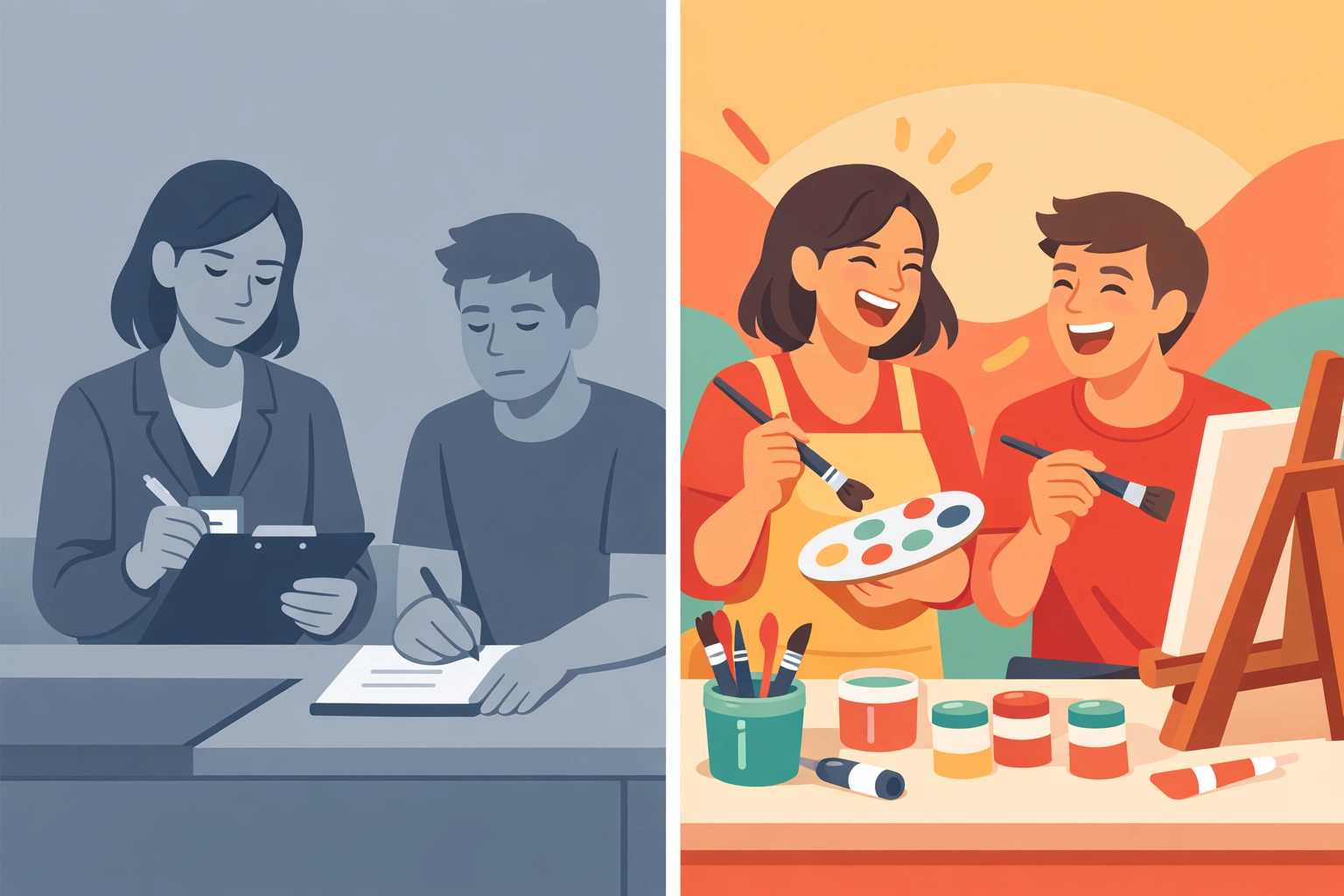
Traditional caregiving agencies have been doing things the same way for decades. They match based on availability, credentials, and geographic proximity. It's efficient, sure. But it's also why so many families cycle through worker after worker, never quite finding "the one."

Here's what usually happens: An agency sends someone with an impressive resume. The worker is qualified, punctual, and perfectly pleasant. They help with daily tasks. They follow the care plan. Everything looks good on paper.
But there's no spark. No shared laughter over inside jokes. No excited conversations about shared interests. It's professional... and that's all it is.
After a few months, the worker moves to another client. The family starts over. The person receiving support has to adjust to someone new, again. And the cycle continues.
We hear this story again and again from Ontario families using Passport funding: the exhaustion of constantly re-explaining preferences, rebuilding trust, starting from scratch with someone new.
What the Coffee Test Actually Measures
The Coffee Test isn't about whether someone can make a proper latte (though that's a bonus). It's a thought experiment that reframes how we think about caregiver matching.
Ask yourself: If these two people met randomly at a coffee shop, would they strike up a conversation? Would they discover common ground? Would they genuinely enjoy each other's company?
If the answer is yes, you've found something that no amount of training can manufacture: authentic compatibility.
This matters more than you might think. Research on relationships consistently shows that couples with similar interests have healthier, longer-lasting connections. The same principle applies to support relationships. When a support worker and the person they're supporting share genuine interests, everything changes.
Tasks stop feeling like items on a checklist. Outings become something both people look forward to. The relationship develops depth that goes beyond the professional boundary, not inappropriately, but meaningfully.
Why Shared Hobbies Create Better Support
Let's get specific about why this matters in real, everyday situations.
1. Motivation becomes mutual
When your support worker genuinely loves hiking and your daughter does too, those Saturday morning trail walks aren't work, they're something both people are excited about. The worker isn't watching the clock. Your daughter isn't being "managed." They're two people enjoying a shared activity.
2. Communication flows naturally
Ever notice how conversations feel easier when you're talking about something you both care about? A support worker who shares your son's passion for video games doesn't need to force small talk. They're already discussing strategies, new releases, favorite characters. Real connection happens in those moments.
3. Learning happens organically
When interests align, teaching and learning stop feeling like formal processes. A worker who loves cooking isn't "doing life skills training" when they're in the kitchen with their client, they're sharing recipes, trying new techniques, genuinely collaborating. The learning is real, but it doesn't feel like work.
4. Relationships withstand challenges
Here's the truth about long-term support: there will be hard days. Days when routines fall apart, when behaviours are challenging, when nothing goes according to plan. Shared interests create resilience in those moments. That foundation of genuine connection, built through countless conversations about shared passions, carries the relationship through difficult times.
How Loom Does Matching Differently
At Loom Care and Connect, we built our entire platform around this insight. When families create profiles, we don't just ask about care needs and scheduling requirements. We dig into interests, hobbies, personality traits, communication styles.
Same with support workers. We want to know what makes them tick outside of their professional credentials. What do they do for fun? What are they passionate about? What kind of person do they connect with most easily?
Then we use that information to facilitate meaningful matches. Our marketplace model puts the power in families' hands, you can browse worker profiles, see their interests listed right alongside their qualifications, and make decisions based on the whole picture, not just a resume.
We're not saying certifications don't matter. Of course they do. But a PSW certificate tells you someone can perform clinical tasks. It doesn't tell you whether they'll connect with your family member over a shared love of true crime podcasts or vintage car restoration.
The Science Behind Compatibility-First Matching
This isn't just feel-good thinking. There's solid research backing up why compatibility matters so much in caregiving relationships.
Studies on caregiver retention consistently show that job satisfaction, which directly impacts how long someone stays in a role, is more closely tied to relationship quality than to pay or benefits. When support workers genuinely enjoy spending time with the people they support, they stay longer, show up more engaged, and provide better care.
From the other side, research on disability support outcomes reveals that individuals receiving care report higher quality of life when they feel genuinely connected to their support workers. It's not just about having tasks completed, it's about feeling understood, valued, and genuinely liked.

Real Matches, Real Impact
Here's what this looks like in practice:
Sarah, a support worker in London, loves musical theatre. She was matched with Emma, a 24-year-old woman with developmental disabilities who had been asking her family to take her to shows for years. Within their first month working together, they'd attended three productions. Emma started participating in a community theatre group. Sarah wasn't "providing community integration support", they were two theatre enthusiasts sharing something they both loved.
Marcus, a recent DSW graduate, is deeply into gaming and anime. He connected with Tyler, a 19-year-old who'd struggled to find support workers who understood his interests. Previous workers had dismissed his hobbies as childish. Marcus got it. They attend gaming conventions together. Tyler's social circle has expanded. His family says he's more confident than he's been in years.
These aren't exceptional cases, this is what happens when matching prioritizes compatibility alongside qualifications.
Practical Tips for Coffee Test Matching
If you're hiring through Passport funding or any direct-hire model, here's how to apply the Coffee Test principle:
During interviews, ask about interests first. Before diving into experience and qualifications, have a real conversation. What do they do for fun? What are they passionate about? See if natural points of connection emerge.
Include your family member in the process. If possible, let the person who'll be receiving support meet potential workers. Watch for genuine connection, not just politeness.
Look beyond the resume. Someone with fewer years of experience but genuine shared interests will often be a better long-term match than someone with an impressive resume and no common ground.
Trial periods are your friend. Use your Passport funding flexibility to do trial shifts. See how the relationship develops in real situations, not just interviews.
Trust your gut. If something feels off, even if someone looks perfect on paper, listen to that instinct. The Coffee Test is as much about intuition as analysis.
The Future of Caregiver Matching
We're at an interesting moment in Ontario's disability support landscape. With Passport funding giving families more control over hiring decisions, we finally have the opportunity to move beyond traditional agency models that prioritize efficiency over compatibility.
At Loom, we're building toward a future where compatibility-first matching is the norm, not the exception. Where shared interests are listed as prominently as certifications. Where the question "Would these two people enjoy spending time together?" is the first thing we ask, not an afterthought.
This approach doesn't just benefit individuals and families, it strengthens the entire caregiving workforce. When support workers genuinely enjoy their work because they connect with the people they're supporting, burnout decreases. Retention improves. The quality of care rises across the board.
Your Move
Here's the bottom line: experience matters. Certifications matter. Professional skills matter. That’s the foundation. It’s what keeps care safe, consistent, and respectful.
But the Coffee Test is the extra layer that turns “qualified” into “right.” Shared interests are the secret sauce that makes someone more likely to show up, stick around, and build real trust over time.
The next time you're hiring a support worker, try the Coffee Test after you’ve confirmed the essentials. Ask yourself, and ask your family member: would these two people enjoy grabbing coffee together? Would they have things to talk about beyond the care plan? Would they look forward to spending time together?
If the answer is yes, you’re not just hiring help—you’re setting up a match that can actually last.
And if you're looking for a platform that puts credentials and connection side by side, we're here to help. Because at the end of the day, we're not just matching workers with clients. We're weaving connections between real people—built on solid experience, and held together by shared joy.
That’s what makes long-term support possible.